AHCC has a 63.6% HPV clearance rate in the most rigorous human trial published to date. That single number has driven enormous interest in this mushroom-derived supplement, and also a wave of marketing claims that go well beyond what the evidence actually supports. Understanding AHCC benefits: what’s proven, what’s not, means separating that one genuinely promising finding from the broader territory of speculation, animal data, and ongoing trials that haven’t yet reported results.
Key Takeaways
- The strongest human evidence for AHCC is in persistent high-risk HPV clearance, one phase II trial showed 63.6% clearance at 3 g/day over six months.
- Immune-modulating effects (increased dendritic cells, T and B lymphocytes) have been observed in healthy volunteers, but these lab changes don’t automatically translate to fewer infections or better clinical outcomes.
- Animal studies suggest antiviral effects against influenza and SARS-CoV-2, but no human trials have confirmed these benefits.
- AHCC is consistently well-tolerated at studied doses, but it is a dietary supplement, not a drug, and no major health agency has endorsed it as a treatment for any condition.
- Several trials are currently in progress, including studies in head and neck cancer and immune checkpoint inhibitor therapy. Results are not yet available.
What AHCC Actually Is
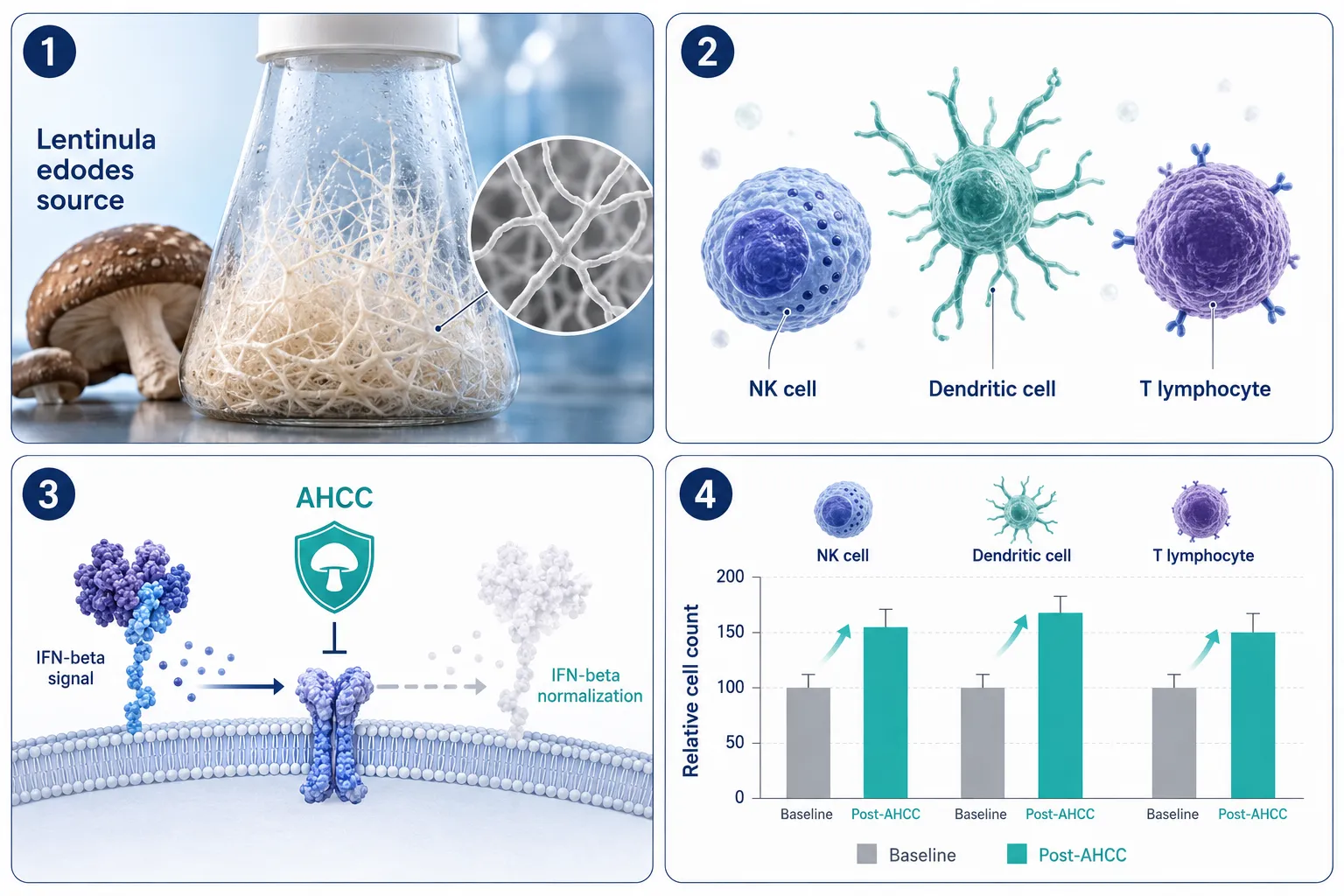
AHCC is a standardized extract made from cultured Lentinula edodes (shiitake) mycelia. The manufacturing process breaks down the cell walls of the mushroom mycelium, producing a mixture of polysaccharides, particularly alpha-glucans, along with amino acids and other compounds. This profile is thought to interact with immune receptors in ways that modulate both innate and adaptive immunity.
The full background on what AHCC is and how it’s made covers the production process in more detail. What matters clinically is that AHCC is not a single active molecule with a known receptor target, it’s a complex extract, which makes predicting its effects in specific diseases more complicated than it might seem from the marketing.
Dosage in research has been relatively consistent: most human trials use 3 g/day taken orally on an empty stomach, for periods ranging from four weeks to six months. That consistency is useful, but it also means that dosing outside these parameters, higher, lower, or combined with other treatments, hasn’t been well studied.
AHCC Benefits: What’s Proven, What’s Not, The HPV Evidence
This is where the evidence is strongest, and it’s worth being precise about what the data actually show.
A randomized, double-blind, placebo-controlled phase II study enrolled 50 women with persistent high-risk HPV infection lasting more than two years. Women in the treatment group took 3 g/day of AHCC for six months. The result: HPV RNA/DNA clearance in 63.6% of treated participants, compared to none in the placebo group. Of those who cleared the virus, about 64.3% maintained that clearance six months after stopping the supplement. No significant adverse effects were reported.
That’s a meaningful finding. Persistent high-risk HPV, the kind that doesn’t clear on its own within the usual one-to-two-year window, is exactly the population at elevated risk for cervical dysplasia and, eventually, cervical cancer. The AHCC for HPV evidence page covers the trial methodology and patient population in more detail.
The trial also identified an immunological pattern: women who cleared HPV on AHCC tended to have interferon-beta (IFN-beta) levels below 20 pg/mL. The hypothesis is that AHCC helps normalize an IFN-beta response that would otherwise blunt effective immune clearance of the virus. This is biologically plausible, but it’s one study’s finding, not yet a validated biomarker.
What this does not mean: AHCC is not a replacement for cervical screening, colposcopy, or the HPV vaccine. If you have a persistent high-risk HPV result on HPV testing, the standard monitoring pathway still applies. Cell changes are easiest to manage before they progress, that’s what screening is for.
What the Ongoing Trials Are Testing
The AHCC4HPV phase II trial (NCT02405533) remains listed in clinical trial databases, with follow-up and analysis continuing through 2025-2026. No new large randomized trials have reported results as of 2026.
Two additional trials are in progress. One is testing AHCC alongside standard chemoradiation in HPV-positive head and neck squamous cell carcinoma. Another is evaluating AHCC as an add-on to immune checkpoint inhibitor therapy in cancer patients, with endpoints including progression-free survival and overall survival. Neither has published outcome data yet. These are expectations, not proven benefits.
What the Immune Data Show, and What They Don’t
In healthy volunteers, a four-week trial at 3 g/day showed significant increases in total circulating dendritic cells, both DC1 and DC2 subsets, and enhanced mixed-lymphocyte reaction, a measure of specific immune activation. T and B lymphocyte counts and neutralizing antibody levels have also been reported to increase in clinical summaries.
These are real immune changes. They provide biological plausibility for AHCC’s effects. But a change in a lab value is not the same as a clinical benefit. Increased dendritic cell counts in a healthy person don’t automatically mean fewer colds, faster recovery from infection, or better cancer outcomes. The evidence shows immune modulation. It does not yet show that this modulation translates to measurable health improvements in most conditions.
For women specifically, the AHCC benefits for women overview covers how these immune effects intersect with HPV-related risk, including the cervical cancer connection explored in more detail on the AHCC and cervical cancer page.
Animal Data: Promising but Not Yet Human Evidence
Multiple preclinical studies show AHCC improving survival in mice after infectious challenge, restoring immune function under stress conditions, and enhancing responses to influenza. A 2023 mouse study found that oral AHCC reduced SARS-CoV-2 replication, attenuated lung inflammation, and boosted virus-specific immune responses.
These findings support biological plausibility. They do not constitute proven human benefits against COVID-19, influenza, or other infections. Animal models of infection often don’t translate directly to human disease, that’s why human trials exist.
One small clinical study in healthy people with depressive symptoms suggested AHCC might enhance sympathetic nervous system activity under stress and improve certain immune parameters. The study was small and conducted in a specific population. It does not establish AHCC as a treatment for depression or anxiety.

Who Should Think Carefully Before Taking AHCC
AHCC is consistently described as well-tolerated at studied doses. Across human and animal studies, few significant adverse events have been reported at 3 g/day over weeks to months. That’s a genuinely favorable safety profile for a supplement.
That said, certain groups warrant more caution:
- People on immune checkpoint inhibitor therapy, AHCC is being studied as an add-on to immunotherapy, but drug-supplement interactions in this context are not fully characterized. Talk to your oncologist before adding any supplement to an active cancer treatment regimen.
- Immunocompromised individuals, including those who are HIV-positive or post-organ transplant, whose immune systems are already being managed pharmacologically. Modulating immune activity in these contexts carries different risks than in healthy adults.
- Pregnant people, AHCC has not been studied in pregnancy, and the general principle of avoiding unstudied supplements during pregnancy applies here.
- People taking complex medication regimens, because AHCC’s interactions with prescription drugs, particularly immunosuppressants, have not been well studied.
AHCC is a dietary supplement, not a drug. It is not formally approved to diagnose, treat, or cure any condition, and product quality can vary between manufacturers.
The Regulatory Reality in 2026
As of 2026, no major health agency, the WHO, CDC, NIH, or ACOG, has issued a formal recommendation that AHCC should replace or supplement standard HPV prevention or treatment. It does not appear in treatment guidelines for HPV, cervical dysplasia, cancer, or any infectious disease.
The AHCC and cancer evidence page covers the oncology research context in more detail, including what the ongoing trials are actually measuring. The general AHCC benefits overview provides a broader summary for those new to the topic.
What the evidence supports is this: AHCC is a biologically active supplement with a plausible immune mechanism, one well-conducted human trial showing meaningful HPV clearance, and several ongoing trials that may expand the picture. What the evidence does not support is using AHCC in place of vaccination, cervical screening, or established cancer treatment.
If you have persistent high-risk HPV and are considering AHCC, the conversation belongs with your clinician, not because the supplement is dangerous, but because the decision about whether to use it should happen alongside, not instead of, standard monitoring. An abnormal Pap smear result or a persistent high-risk HPV finding has a defined clinical pathway, and AHCC doesn’t yet have a defined place in that pathway.
Frequently Asked Questions
Can AHCC clear HPV on its own without other treatment?
The phase II trial showed HPV clearance in 63.6% of women with persistent high-risk HPV who took 3 g/day for six months. However, this was a single mid-size study, and it hasn’t been incorporated into clinical guidelines. AHCC should be considered alongside, not instead of, standard HPV monitoring and cervical screening.
How long does AHCC need to be taken to see an effect on HPV?
The HPV clearance trial ran for six months at 3 g/day. Shorter durations (four weeks) have shown immune-parameter changes in healthy volunteers but not viral clearance data. There’s no established minimum duration for clinical benefit, and this varies person to person.
Does AHCC interact with cancer treatments?
This is an active research question, not a settled one. A trial is currently evaluating AHCC alongside immune checkpoint inhibitors. Until results are available, anyone on active cancer treatment should discuss AHCC with their oncologist before starting it, not because harm is established, but because interactions haven’t been fully characterized.
Is AHCC the same as taking a shiitake mushroom supplement?
No. AHCC is made from cultured shiitake mycelia using a specific fermentation and extraction process that produces a standardized alpha-glucan profile. Whole shiitake mushrooms or standard shiitake extracts have a different composition and have not been studied in the same way.
Does AHCC prevent HPV infection?
There is no evidence that AHCC prevents initial HPV infection. The research has focused on clearing persistent existing infection, not on prevention. The HPV vaccine remains the evidence-based tool for preventing infection with high-risk types like HPV 16 and 18.
Where does AHCC fit if I already have an abnormal Pap result?
It doesn’t replace any part of the standard pathway, colposcopy, biopsy if indicated, and follow-up based on your specific result (ASC-US, LSIL, HSIL). Some people with persistent high-risk HPV ask their clinician about AHCC as an adjunct while under surveillance. That conversation is worth having with your doctor, with the current evidence clearly on the table.